Confused between MDF and Plywood for your home in Dubai or Al Ain? Read our 2026 expert guide by Al Baraka Wood on prices, durability, and moisture resistance.
Understanding MDF (Medium Density Fiberboard)
MDF is an engineered wood product made by breaking down hardwood or softwood residuals into wood fibers, combining it with wax and a resin binder.
- Best For: Smooth painted finishes, intricate CNC carvings, and decorative wall panels.
- Pros: It has a very smooth surface with no knots. It is easy to cut and paint, making it look very premium.
- Cons: It is not moisture-resistant. If exposed to water, it can swell and lose its shape.
Understanding Plywood (The Marine Grade Standard)
Plywood is manufactured from thin layers or “plies” of wood veneer that are glued together with adjacent layers having their wood grain rotated up to 90 degrees to one another.Best For: Kitchen carcasses, bathroom vanities, and heavy-duty shelving.Pros: Extremely strong and durable. For the UAE climate, Marine Plywood (IS:710) is the gold standard because it is waterproof and holds screws very tightly.Cons: It is more expensive than MDF and usually requires edge-banding or veneer to achieve a smooth finish.
Side-by-Side Comparison (2026 UAE Market)
Feature MDF Plywood (Marine Grade)Durability Moderate HighMoisture Resistance Low (Swells easily) Excellent (Waterproof)Cost (Estimated) AED 45 – 65 per sheet AED 85 – 175 per sheetSurface Finish Perfectly Smooth Needs Veneer/LaminateBest Use Wardrobe
The Expert Verdict for Al Ain & Dubai Homes
For a long-lasting interior, we recommend a Hybrid Approach. Use Marine Plywood for the internal structure of your cabinets (where moisture or weight is a factor) and use High-Gloss or Matte MDF for the external doors and shutters to achieve a flawless, modern look.Work with Al Baraka Wood TodayLocated in Al Ain, Al Baraka Wood is your trusted partner for high-quality carpentry and premium wood supplies. We ensure that your furniture is built to survive the UAE’s unique climate.Contact Number: +971 52 7054436
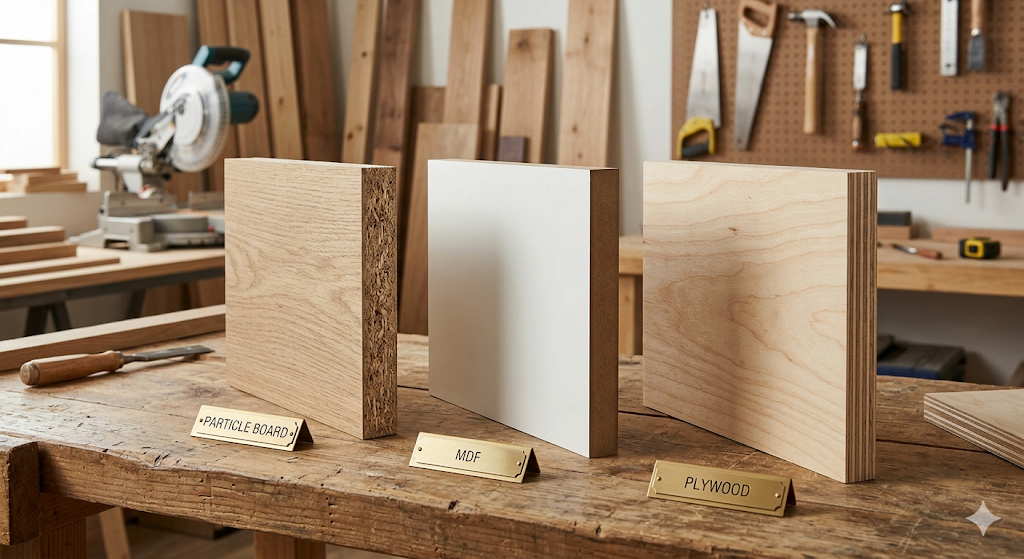
Choosing the right material for furniture and interior projects is crucial for durability and aesthetics. Here is a comprehensive comparison between Particle Board, MDF, and Plywood—optimized for SEO and professional use.
1. Particle Board (The Economical Choice)
Particle board is an engineered wood product manufactured from wood chips, sawmill shavings, or even sawdust, which are pressed together with a resin or binder.
- Structure: It has a relatively coarse texture and is the lightest of the three materials.
- Best For: Budget-friendly furniture, temporary office partitions, and flat-pack (RTA) furniture.
- Pros: Very cost-effective and provides a smooth surface for laminates.
- Cons: Low durability. It tends to sag under heavy weight and expands significantly if exposed to moisture or humidity.
2. MDF – Medium Density Fiberboard (The Designer’s Favorite)
MDF is made by breaking down hardwood or softwood residuals into wood fibers. These fibers are combined with wax and a resin binder and formed into panels by applying high temperature and pressure.
- Structure: It is much denser and smoother than particle board. It has no visible grain or chips.
- Best For: Custom kitchen cabinets, intricate wardrobe doors, and decorative wall panels. It is the best material for CNC routing and high-gloss paint finishes.
- Pros: It is very easy to cut and drill without splintering. Its surface is perfectly smooth for painting.
- Cons: Like particle board, it is not water-resistant unless specifically treated. It is also quite heavy.
3. Plywood (The Premium Standard)
Plywood is made by gluing together thin layers of wood veneers (plies) at 90-degree angles to one another. This “cross-graining” technique creates immense structural strength.
- Structure: You can see the distinct layers on the edges.
- Best For: High-end wardrobes, bed frames, kitchen carcasses (especially near sinks), and heavy-duty shelving.
- Pros: Exceptional strength and screw-holding capacity. It is much more resistant to moisture (especially BWP or Marine Grade) and does not sag over time.
- Cons: It is the most expensive option and requires edge banding or molding to hide the layered edges.
Technical Comparison Table
| Feature | Particle Board | MDF | Plywood |
| Cost | Lowest | Moderate | High |
| Strength | Low | Moderate | High |
| Moisture Resistance | Very Low | Low | High (BWP Grades) |
| Surface Finish | Laminate/Veneer | Paint/Polish/CNC | Laminate/Veneer |
| Durability | Short-term | Medium-term | Long-term |
SEO Optimization Guide
If you are publishing this on a professional woodworking or construction blog, use these parameters:
- Target Keywords: Best material for kitchen cabinets, Plywood vs MDF, furniture wood types, durable woodworking materials.
- Internal Linking: Link to your specific tools, such as a wood weight calculator or custom cabinetry services, to increase user engagement.
- Meta Description: “Confused between Particle Board, MDF, and Plywood? Learn the key differences in strength, cost, and moisture resistance to choose the perfect material for your next furniture project.”
Final Verdict
For high-traffic areas or items carrying weight (like beds and main cabinets), Plywood is the winner. For decorative items or painted finishes, MDF is superior. If you are working on a strict budget for temporary use, Particle Board serves the purpose.